
A Conversation with Molly Lambert, Creator of JENNAWORLD
"I think [people in the porn industry] have always been ahead on media shifts, and I think people would do well to pay attention to them"


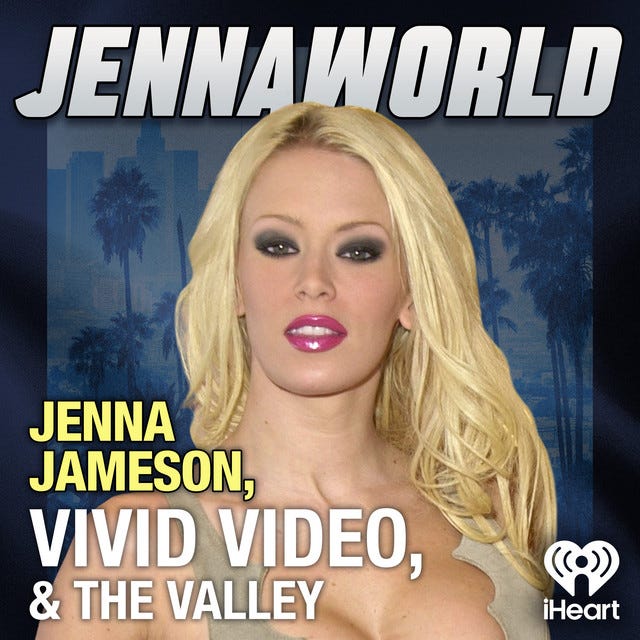
High Femme had the chance to talk with Molly Lambert, creator of JENNAWORLD and HEIDIWORLD, about 1990s porn icon Jenna Jameson, the state of the adult industry (past, present, and future), and modern digital life. Her podcasts can be found on any major streaming platform.
VERONICA: What I like so much about your work is that it’s very thesis-driven, but also hinges on highly specific research. Do you have a strategy for balancing between research versus the point you’re hoping to make?
MOLLY: God, I mean, not really. I think I just get hyper fixated on things and then you just can’t stop, kinda. I think [JENNAWORLD] came about because I was always interested in the contract girl model for porn, which is sorta the porn studio system model, where they manufacture their own stars. And then the podcast ended up turning into a piece on the collapse of media in the twenty-first century. It’s really about the end of monoculture. There was this monoculture, and [Jenna Jameson] was really a big star in that time period, and now we don’t have big porn stars in the same way that we don’t have a monoculture anymore. […] Something I’ve learned from doing this show is that most people don’t know who Jenna Jameson is. The fact that she was so incredibly famous and now has fallen out of the cultural zeitgeist I thought was really interesting.
VERONICA: Do you have any guesses to why that is? I feel like if you knew even a handful of things about the 1990s and early 2000s you would know her name.
MOLLY: I just think culture moves in much faster cycles now. People get famous on social media and YouTube and then become unfamous really fast. The idea that someone like Jenna became so famous and stayed so famous for a period of like ten years is just unthinkable for anyone now. The cycles are so much faster for fame.
VERONICA: Do you remember when you personally became conscious of her?
MOLLY: I totally don’t. It must have been from seeing her on the E! Channel, probably? But she was such a cultural touchstone, and porn was such a punchline all the time for people, you know? […] She branded herself so well that she became shorthand for porn stars. […] It was good content, so to speak, to have her having these adversarial conversations about porn with people like Bill O’Reilly and Howard Stern and Jerry Springer. Although she reached a point in the mid early 2000s where that stopped working for her and the media apparatus started to turn on her and criticize her for not showing up to things and being out of it on local news shows. I think it demonstrated that no matter how big you can get, the machine can always decide to take you back down.
VERONICA: Do you think the media turning on her was part of a specific cultural shift, or was it the fact that we can only hold our attention on something or someone in the public eye for so long?
MOLLY: She just became so oversaturated that people were like, “Well, now we’re sick of you.” This happens a lot with stars, especially female stars. We’re seeing it right now with Sydney Sweeney, where once people start jumping off the bandwagon then jumping off the bandwagon becomes its own kind of cultural movement.
VERONICA: Do you remember a definitive moment that got you into researching the porn and sex industry?
MOLLY: I think I just always thought it was funny that there was an underground film industry in the Valley that was a shadow film industry. It was more low-budget and more blue-collar. Also the adult classifieds in the back of the LA Weekly. I just think when you’re young you’re like, “What is this whole hidden world of stuff that I’m probably not supposed to know about?” And then I went to the AVN Awards and some conventions, and you do see that everyone in the industry knows each other, and that it’s very small in some ways. It relates back to the way that LA is actually a very small town. […] There’s a mundane reality behind the fantasy image-making. There are people that are just grips and boom mic operators, and all the kind of “boring” stuff that goes into making something a larger than life fantasy. Which is really, I guess, just the film industry at large, but I always liked the porn industry’s scrappier underground version of that. They were making movies that were making so much money at a certain point, but people refused to respect it because they were sex movies.
VERONICA: A broader question: from Jenna Jameson’s time to now, what do you feel like has stuck in the adult industry and what do you think has changed? Do you think it’s shifted for better, for worse?
MOLLY: I think most people don’t even know that the industry collapsed, really, because they aren’t conscious of how the business worked. A big thing that spurred me to do this podcast was finding out about this time where the industry was collapsing into tech, and people in the adult industry were signalling the alarm that this was also going to happen to the rest of media. And then it did, but because that warning was coming from porn, people didn’t take it seriously and didn’t think it would affect them. […] I think [people in the porn industry] have always been ahead on media shifts, and I think people would do well to pay attention to them, even now, regarding what they have to say about content and ownership. I think a lot of people still think the porn industry is the 90s porn industry, and so when they talk about porn they’re thinking about huge-breasted blonde women of a certain era — of Jenna’s era — and really when the Internet came into play what you had was a lot of different kinds of people. Sasha Grey was the last major crossover porn star. Her and Asa Akira were part of an early 2000s wave of Internet porn stars who didn’t have to go through the traditional systems at all. Old-school porn stars had to start in stripping and then move into girl-girl softcore and then move into hardcore, but people like Sasha Grey were doing incredibly hardcore stuff right away. The whole order of operations ceased to exist. I think there are things that were good about the studio system — it felt more stable, you could work for one studio for a longer period of time — but there are things that are good about how things work now. Creators make the vast majority of profit on their own content, because they’re shooting their own content, producing their own content. Basically everyone who does porn now knows how to direct and edit and do sound, and you used to need a whole industry as an apparatus to do that. It’s like a lot of things about the Internet, there’s less of a barrier of entry but it’s also much harder to make a dent and get any kind of foothold. It’s also just become much more saturated, a lot more people make adult content now.
VERONICA: It’s interesting, when I read Jenna’s book, I was struck by the way that while she talks about working long hours and being tired, she also had a relatively metered experience with guardrails. I think now, people self-producing porn online have more of an obligation to constantly be working.
MOLLY: Yeah, I think that reflects the way our work culture has shifted with the Internet. Everybody works 9 to 9 now, there’s no time you can’t get an email about work. You’re always at work and you’re always not at work. I think Jenna also very much predicted the rise of the influencer, and it turns out that she lived next to the Kardashians at one point. I think the Kardashians were definitely looking to Jenna as someone to emulate as someone just getting their name out there, whatever it takes. […] This idea that it doesn’t matter what you get famous for, you just get famous, is kind of the goal of American life for many people now. Which I think reflects that it’s hard to make a living off of traditional jobs. I think a lot of people see this ability to commodify themselves as their only real chance to make money.
VERONICA: It can feel inevitable now that you have to be brandable even for “normal” work, whatever that would be.
MOLLY: Yeah I mean I always loved the movie Showgirls, which I think is a movie about sexual commodification in America and the hypocrisy around it. There’s that part in Showgirls where Cristal says to Nomi, “Sooner or later you’re gonna have to sell it.” Which I think is the message we all get as people in this society where there’s no social safety net. Your self is the one thing you can buy and sell.
VERONICA: Do you have a utopian vision for how we treat the adult industry and pornography?
MOLLY: I mean I think I thought during the Jenna era that things were just going to keep getting better. I was like, “People are going to take women seriously even if they get their tits out. We’re gonna have respect for that now.” But, obviously there was a huge backlash that started, mainly online, where it was like, “No, we’re not going to have that. We’re going to put women back in their place as an underclass.” I just think that even if we abolished capitalism, which we obviously should, there would be people who want to make pornographic movies because it’s an art form, and because sex is a huge part of the human experience. Sex has gone so out of mainstream movies and television because of this globalization where they don’t want to offend anyone internationally. The fact that people aren’t really trying to represent sexuality and sensuality in mainstream entertainment really puts it all on porn, and then people get mad that they think porn isn’t an accurate representation of human sexuality. But that’s because it’s this fantasy representation, and it’s always been meant to be this fantasy exaggerated world, kinda like wrestling. It’s a funhouse mirror of American culture. But I also think media literacy has gone so down that people can’t really tell the difference between screen images in real life in the same way people used to assume they could. […] There was a period where it was taboo and outre to put your face on the Internet, it was considered something that was just for freaks, really, or people who didn’t care what happened. […] The screen world isn’t real, but that doesn’t mean it shouldn’t exist. It’s a sort of dream world, in a way. […] So many people are expected to present themselves visually online for their jobs now, for all sorts of jobs that you wouldn’t have had to before, even in terms of Zoom meetings. We’re all expected to show up onscreen and be in charge of our screen image. I think porn stars have always been ahead on that as well, asking, How do you monetize your presence in the world if that’s what you’re expected to do? A lot of people who look down on porn or think porn is not good for people who do it are doing the exact same thing on Instagram. They’re showing pictures of their lives and saying “I’m living an aspirational life and you should look up to me for it.” I think bringing back the boundaries between this fantasy world and reality is important.
VERONICA: I think there’s a value to the fantasy that porn presents more than than there is us digitally marketing ourselves and claiming it’s “real”.
MOLLY: Yeah. I think people don’t think about it as an outlet for our fantasies. For women, a lot of it is about the fact that they feel degraded in their everyday life, and so porn can be an outlet for these feelings about power and control in either direction. It doesn’t necessarily mean you want to do the things you’re watching, it just means it’s a fantasy. I think with the Internet in general, there’s this very one-to-one experience now where everything everyone says online is 100% true, whereas when I was first online everyone was aware that we were all playing characters online, or exaggerated versions of ourselves. When people meet porn stars in real life they’re often like, “You’re different than the fantasy I had of you in my head”. Now that happens to lots of people, it’s happened to me in both directions. People meet me and go, “Oh my God, you’re short.” […] Some of the efforts to ban porn, which has become a big movement again in the right wing and among neoliberals who don’t know any better, comes from a belief that we need to get rid of fantasy and escapism, and everything needs to be happening in real life, as if that will get rid of people’s fantasies and “fix it”. I feel like any attempt to legislate people’s fantasy lives is going to fail, because you can’t go in people’s heads and tell them what to think about.
VERONICA: People are going to have fantasies and desires that are complex and contradictory and nuanced regardless of what we explore externally.
MOLLY: I think the more you repress it the crazier it gets. I think the American approach has always been to put it under a rock but constantly be looking under the rock. People in porn are always talking about the difference in European culture. People in European culture have topless beaches and places that aren’t sexualized, and so all nudity doesn’t become especially sexualized. Even with stuff like breast feeding, there’s such a culture of repression around sex and nudity and bodily autonomy that people think all nudity is sexual and that all bodily expression is pervert stuff.
VERONICA: I think sometimes making a space of repression and fear is a different way to obsess over and deify sexuality. Something about the obsession and policing is perverted, too.
MOLLY: Definitely. That’s who’s concerned about it, too. A lot of the reason people on the right want to ban porn or make it so hard to do that it becomes de facto illegal is because they’re afraid of what they might get into. A lot of it turns out to be that they’re afraid of people being attracted to trans people, and that’s their own fear that they’re projecting on everything. Obviously it’s complicated with trans performers because there’s this fetishization that happens. The representation and fetishization of anyone marginalized in porn is very complicated. But when things are complicated, there seems to be an urge to completely get rid of it. No one wants to deal with the complicated nature of real life, and so they want to reset back to this imaginary idea of an America where everybody is in a monogamous nuclear family. That’s not what was happening then, either! Sure people were getting married and having kids, but they also had secret lives. A lot of it comes down to these issues of self-control. That’s the other fear people have about porn. You see it now a lot with these fears of gooners, of porn addiction, this sensationalist stuff you hear about. Americans have no impulse control, there’s no effort to make people say no to things. There’s an expectation that you get everything you want all the time, and it’s crazy and it’s why they’re killing the planet. If somebody watches porn non-stop, they’re kind of just hurting themselves. I also think that’s overblown as a fear. People sometimes maybe go through a phase of watching too much porn, but I think it won’t ever replace the human experience. And if someone just wants to masturbate all day, who cares? They’re allowed to do that. To me, it’s really a reflection of this screen culture we have where people expect constant novelty all the time, and we have that in the place of a social safety net. I don’t think people watching porn all the time is really the issue, but I think people like ordering from Amazon and needing workers who are exploited to bring them stuff constantly. That to me is what’s really fucked up. […] People are always like, “What about the workers being exploited in porn?” And it’s like well they’re not necessarily being exploited, it depends on the conditions of the labor, how much they’re getting paid, whether they can speak up and say no to things. People who drive for Amazon can’t speak up and say no to things, they are being exploited. I wish people would take some of the concern-trolling they have for people who take off their clothes online and apply it to actual workers that are actually being exploited by these big companies. […] And you know there’s porn I don’t believe in. Porn is still very racist. People have tried to make the industry better in that way but it always seems to reset back to being racist, and… I don’t know, I just think now there’s a greater breadth of content than there’s ever been, so when people say it’s giving people unrealistic ideas, it’s like, there’s all kinds of things. You can watch amateur people have sex if you want to, you can not watch porn at all, but it’s all about bodily autonomy at the end of the day.
RAPID FIRE QUESTIONS:
HF: What’s your biggest time suck online?
ML: TikTok. I was gonna say Wikipedia, but that was a lie. It’s TikTok.
HF: Favorite curse word?
ML: Probably fuck.
HF: Favorite perverted thing (it can be art, an object, a person, a sex act, whatever)?
ML: I like when people have a weird one. Sploshing, or something.
HF: What’s a sex discourse you wish you could ban?
ML: Everybody’s really concerned about choke sex, and I feel like it’s a little overblown. I feel like the discourse on porn is a little too focused on men.
HF: Do you call it a journal or a diary?
ML: I don’t call it either because I’ve never kept one.
HF: Favorite book from childhood?
ML: I was really into Benjamin Franklin’s diary, for some reason.
HF: Song of the spring?
ML: I’m really into listening to CDs that I bought for a dollar. So I’ve been driving around listening to Bruce Springsteen’s Tunnel of Love
HF: Person dead or alive that you would ask to dinner with the sole purpose of getting to throw a drink in their face?
ML: Ronald Reagan.
HF: Ideal nap length?
M: Twenty minutes. You can’t do better than that, any longer and you swim out too deep.
HF: Best time to write?
M: I used to be a real nighttime person but now it’s middle of the day.
HF: Worst place to edit writing?
ML: A Starbucks.
HF: Any opinion on any movie ever?
M: No!
OK, no, I’ll give a real answer. I don’t go to the theater that much. M. Night Shymalan’s Trap was awesome.
 | A guest post by
|